

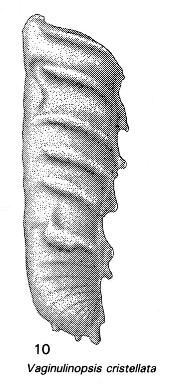
 Hornibrook et al. 1989, Fig. 19.10: 2.40 mm |
Reference: Hornibrook, Brazier & Strong 1989, p.102, Fig. 19:10.
Synonymy: 1864, Marginulina cristellata, Novara-Exped. geol. 1(2): 212, pl. 22, fig. 44;
1971, Vaginulina cristellata, Hornibrook, N.Z. Geol. Surv. 43: 39, pl. 8, fig. 128, 129.
Description: Elongate, almost straight for most of its length, but with a curved initial half coil in microspheric form; later sutures heavily limb ate with strong spines on the inner margin and on the prolocular area.
Comparison: Populations transitional between C. cristellata (with spines) and V. recta (clifdenensis) without spines, occur in the basal part of the Otekaike Limestone (Duntroonian to basal Waitakian) at Kokoamu Cliff, Waitaki Valley.
Distribution: Whaingaroan to basal Waitakian.
Comment: The generic distinction between Vaginulinopsis (Silvestri 1904; partly coiled initially) and Vaginulina (d'Orb 1826; uncoiled initially) seems of dubious value. However, the species with limbate sutures and knobs and spines, in the Paleogene of New Zealand (V. waiparaensis, V. marshalli, V. marwicki, V. interrupta, V. cristellata, V. spinulosa, V. hochstetteri) seem to constitute a valid and useful group.
Cite this publication as: "Strong CP, Raine JI, Terezow M. 2018. Key
species of New Zealand fossil foraminifera: descriptions from "Manual of New
Zealand Permian to Pleistocene Foraminiferal Biostratigraphy" by Hornibrook,
Brazier and Strong, 1989. Lower Hutt (NZ): GNS Science. (GNS Science
miscellaneous series; 123)."
ISSN 1172-2886, ISBN 978-1-98-853088-8,
DOI 10.21420/G2M63W.
This publication is © copyright in 2018 by GNS Science and is licenced for re-use under a Creative Commons Attribution 4.0 International Licence. Please note that this licence does not apply to any included logos, emblems or trade marks.