

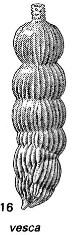
 Hornibrook et al. 1989, Fig. 37.16: 0.81 mm |
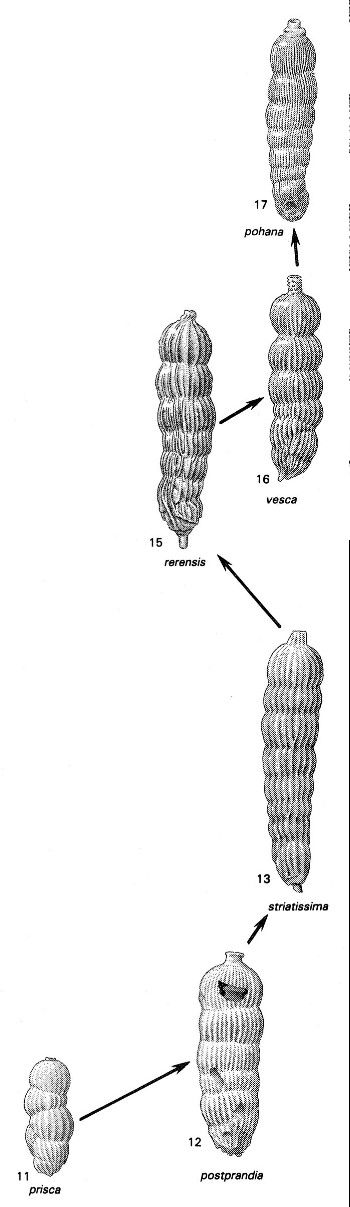 Hornibrook et al. 1989, Fig. 37. Rectuvigerina lineage |
Reference: Hornibrook, Brazier & Strong 1989, p.159, Fig. 37:16.
Synonymy: 1939, Siphogenerina vesca, Trans. Roy. Soc. N.Z. 69(1): 109, pl. 13, fig. 46, 47.
Description: Short triserial initial part followed by a long uniserial stage. They are typically costate, are round in cross section, and have a tubular lipped aperture with an internal toothplate. Lillburnian specimens differ from rerensis in being narrower, with finer and more numerous ribs, and with more constricted chambers.
Distribution: Although vesca is characteristic of Lillburnian in some areas, a very similar form occurs in the Pareora Series and its range and affinities are uncertain.
Comment: This is the form commonly found in the Lillburnian on the west coast of the South Island and the east coast of the North Island (Vella, 1961, Micropaleontology 7(4): 469, fig. 3).
Cite this publication as: "Strong CP, Raine JI, Terezow M. 2018. Key
species of New Zealand fossil foraminifera: descriptions from "Manual of New
Zealand Permian to Pleistocene Foraminiferal Biostratigraphy" by Hornibrook,
Brazier and Strong, 1989. Lower Hutt (NZ): GNS Science. (GNS Science
miscellaneous series; 123)."
ISSN 1172-2886, ISBN 978-1-98-853088-8,
DOI 10.21420/G2M63W.
This publication is © copyright in 2018 by GNS Science and is licenced for re-use under a Creative Commons Attribution 4.0 International Licence. Please note that this licence does not apply to any included logos, emblems or trade marks.