

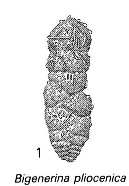
 Hornibrook et al. 1989, Figs 23.1: 0.94 mm |
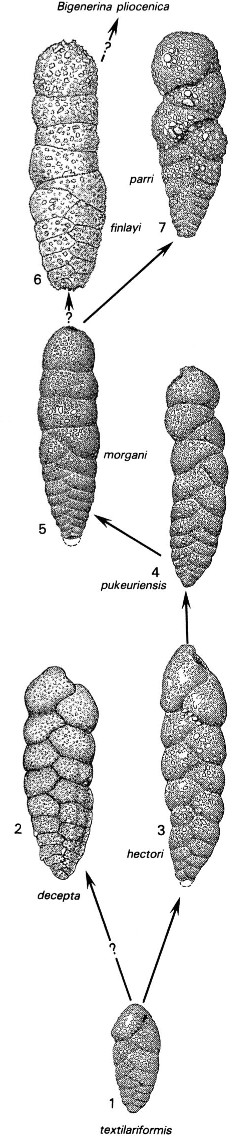 Hornibrook et al. 1989, Fig. 34 Haeuslerella bioseries |
Reference: Hornibrook, Brazier & Strong 1989, p.86; 152, Figs 23:1, 34.
Synonymy: 1939, Trans. Roy. Soc. N.Z. 69(3): 311, pl. 24, fig. 15 (Haeuslerella).
Description: Distinguished by the coarse-grained cylindrical test with a preference for sponge spicules, initially biserial then uniserial for several chambers; aperture terminal. Populations include a range of variation, some individuals changing abruptly from a short biserial to a long uniserial habit, and others with a longer biserial stage. The test walls are usually composed of large sand grains and sponge spicules and the large, stout, cylindrical test usually with a long uniserial stage, sets it apart from the more typical, contemporaneous Haeuserella species.
Distribution: Upper Tongaporutuan? to Kapitean to Nukumaruan. A preferentially deep water taxon.
Comment: Its sudden appearance in the Kapitean (or possibly Upper Tongaporutuan) suggests either rapid adaptation of a Haeuslerella species to deeper water or arrival of an immigrant species.
Cite this publication as: "Strong CP, Raine JI, Terezow M. 2018. Key
species of New Zealand fossil foraminifera: descriptions from "Manual of New
Zealand Permian to Pleistocene Foraminiferal Biostratigraphy" by Hornibrook,
Brazier and Strong, 1989. Lower Hutt (NZ): GNS Science. (GNS Science
miscellaneous series; 123)."
ISSN 1172-2886, ISBN 978-1-98-853088-8,
DOI 10.21420/G2M63W.
This publication is © copyright in 2018 by GNS Science and is licenced for re-use under a Creative Commons Attribution 4.0 International Licence. Please note that this licence does not apply to any included logos, emblems or trade marks.