

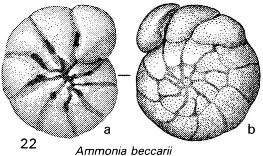
 Hornibrook et al. 1989, Fig. 23.22a-b: 0.63 mm |
Reference: Hornibrook, Brazier & Strong 1989, p.84, Fig. 23:22a-b.
Synonymy: 1940, Streblus aoteanus, Trans. Roy. Soc. N.Z. 69(4): 461;
1967, Ammonia aoteanus, Hedley, Hurdle & Burdett, N.Z. Dep. Sci. Industr. Res. bull. 180: 47, pl. 11, fig. 4A-C; text- fig. 56-60.
Description: Smooth, inflated, evolute dorsally involute ventrally with deep umbilical sutural clefts and a variable umbilical plug.
Distribution: Kapitean to Recent. A. beccarii or closely related forms occur all over the world, being most common in shallow muddy reaches of the intertidal zone, but not found alive on the outer shelf. Rare in Kapitean, common in some inner shelf facies of Wanganui Series and Recent..
Comment: Recorded from Upper Oligocene in Europe. How A. beccarii reached New Zealand in the Late Miocene, probably during a time of low sea level, is an interesting question.
Cite this publication as: "Strong CP, Raine JI, Terezow M. 2018. Key
species of New Zealand fossil foraminifera: descriptions from "Manual of New
Zealand Permian to Pleistocene Foraminiferal Biostratigraphy" by Hornibrook,
Brazier and Strong, 1989. Lower Hutt (NZ): GNS Science. (GNS Science
miscellaneous series; 123)."
ISSN 1172-2886, ISBN 978-1-98-853088-8,
DOI 10.21420/G2M63W.
This publication is © copyright in 2018 by GNS Science and is licenced for re-use under a Creative Commons Attribution 4.0 International Licence. Please note that this licence does not apply to any included logos, emblems or trade marks.