

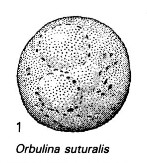
 Hornibrook et al. 1989, Fig. 28.1: 0.45 mm |
 Hornibrook et al. 1989, Fig. 31 |
 Hornibrook et al. 1989, Fig. 31 Orbulina bioseries |
Reference: Hornibrook, Brazier & Strong 1989, p.136, Fig. 28:1, 31.
Synonymy: 1951, Contr. Cushman Fdn 2(4): 135, text-fig. 2, fig. 1, 2, 5-8, 10, text-fig. 3, fig. 3-8, 11, 13-16, 18, 20-22, text-fig. 4, fig. 2-4, 7-12, 15, 16, 19-22;
1969, Hornibrook in Wood, N.Z. Geol. Surv. bull. n.s. 79: 102-108, fig. 43-45;
1971, Jenkins, N.Z. Geol. Surv. paleont. bull. 42: 192, 193, pl. 23, fig. 659;
1983, Kennett & Srinivasan, Neogene Planktonic Foraminifera, p. 86, pl. 20, fig. 1-3, text-fig. 11 (Candorbulina universa).
Description: Completely spherical, pore-like apertures ('megapores') beginning to move away from the sutures of the embryonic chambers and become areal (Lillburnian onwards).
Distribution: Lillburnian.
Comment: First evolutionary appearance marks the base of the Lillburnian in the stratotype at Clifden. The transition to typical O. universa takes place in the Lillburnian but morphotypes of O. suturalis (mostly immature O. universa) are still found higher in the Miocene, particularly in neritic facies.
Cite this publication as: "Strong CP, Raine JI, Terezow M. 2018. Key
species of New Zealand fossil foraminifera: descriptions from "Manual of New
Zealand Permian to Pleistocene Foraminiferal Biostratigraphy" by Hornibrook,
Brazier and Strong, 1989. Lower Hutt (NZ): GNS Science. (GNS Science
miscellaneous series; 123)."
ISSN 1172-2886, ISBN 978-1-98-853088-8,
DOI 10.21420/G2M63W.
This publication is © copyright in 2018 by GNS Science and is licenced for re-use under a Creative Commons Attribution 4.0 International Licence. Please note that this licence does not apply to any included logos, emblems or trade marks.