

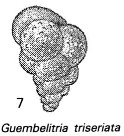
 Hornibrook et al. 1989, Fig. 26.7: 0.16 mm |
Reference: Hornibrook, Brazier & Strong 1989, p.136, Fig. 26:7.
Synonymy: 1882, Textilaria triseriata, Soc. Geol. France Mem. Paris, ser 3. 2(3): 145, pl. 15, fig. 10;
1969, Guembelitria stavensis Bandy, Ludbrook and Lindsay, Proc. First Int. Conf. Planktonic Microfossils, Geneva, 1967, 2: 366-374, pl. 1, fig. 2;
1978, G. samwelli, Jenkins Jl. foram. Res. 8(2): 132-7;
1985, G. triseriata, McGowran and Beecroft, Dept. Mines and Energy, S. Austr. Spec. Publ. 5: 247-261, pl. 2, fig. 1-18, pl. 3, fig. 1-15, pl. 4, figs. 1-19 (Jenkinsina).
Description: Tiny, triserial, about 4 whorls of bulbous chambers, aperture umbilical, usually a high, lipped arch at base of final chamber; surface finely tuberculate or smooth. Resembles a triserial smooth Chiloguembelina.
Distribution: Waipawan to lower Waitakian. The genus has been found earliest in the Tumaio Limestone, Chatham Is. (Waipawan Stage, Upper Paleocene, with Tappanina cf. glaessneri, Globorotalia reissi, G. australiformis) where it is somewhat smaller, though otherwise little different from the Oligocene forms. Guembelitria has also been found sporadically in the Lower and Middle Eocene in New Zealand and is most common in the Middle and Upper Oligocene in fine-grained sediments from oceanic environments (e.g. Amuri Limestone equivalent on the Chatham Rise). Specimen figured is from I40/f9711, basal Kokoamu Greensand, Otekaike River, Upper Whaingaroan.
Comment: Because of its minute size, Guembelitria is often overlooked and the sporadic records of its occurrences are partly due to this factor. Jenkins (1978) proposed that Guembelitria, distinguished as a new species, G. samwelli, and recorded as G. stavensis Bandy, from the uppermost Eocene and Oligocene of South Australia, migrated eastwards with the opening of Bass Strait, being present in a narrow zone within his G. euapertura-zone in the Great South Basin. However, Guembelitria is now known to be present in New Zealand in the Dannevirke, Arnold and Landon Series up to the G. dehiscens-zone. We follow McGowranand Beecroft (1985) in referring all these Guembelitria forms to G. triseriata.
Cite this publication as: "Strong CP, Raine JI, Terezow M. 2018. Key
species of New Zealand fossil foraminifera: descriptions from "Manual of New
Zealand Permian to Pleistocene Foraminiferal Biostratigraphy" by Hornibrook,
Brazier and Strong, 1989. Lower Hutt (NZ): GNS Science. (GNS Science
miscellaneous series; 123)."
ISSN 1172-2886, ISBN 978-1-98-853088-8,
DOI 10.21420/G2M63W.
This publication is © copyright in 2018 by GNS Science and is licenced for re-use under a Creative Commons Attribution 4.0 International Licence. Please note that this licence does not apply to any included logos, emblems or trade marks.