

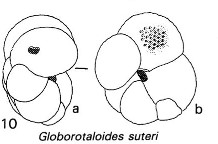
 Hornibrook et al. 1989, Fig. 26.10a-b: 0.40 to 0.50 mm |
Reference: Hornibrook, Brazier & Strong 1989, p.135, Fig. 26:10a-b.
Synonymy: 1957, Bull. U.S. Natl. Mus. 215: 117, pl. 27, fig. 9a-13b;
1971, Jenkins, N.Z. Geol. Surv. paleont. bull. 42: 189, 190, pl. 22, fig. 646-648.
Description: Juveniles have a Globorotalia-like stage. Adults have three to four large embracing smooth chambers in the final whorl and a low arched umbilically situated lipped aperture often covered by a large bulla, opening into the umbilicus.
Comparison: Distinguished from G. testarugosus by the smoother chamber surfaces.
Distribution: Kaiatan to Lillburnian. Especially common in oceanic facies in the upper part of the G. euapertura-zone (Duntroonian).
Cite this publication as: "Strong CP, Raine JI, Terezow M. 2018. Key
species of New Zealand fossil foraminifera: descriptions from "Manual of New
Zealand Permian to Pleistocene Foraminiferal Biostratigraphy" by Hornibrook,
Brazier and Strong, 1989. Lower Hutt (NZ): GNS Science. (GNS Science
miscellaneous series; 123)."
ISSN 1172-2886, ISBN 978-1-98-853088-8,
DOI 10.21420/G2M63W.
This publication is © copyright in 2018 by GNS Science and is licenced for re-use under a Creative Commons Attribution 4.0 International Licence. Please note that this licence does not apply to any included logos, emblems or trade marks.