

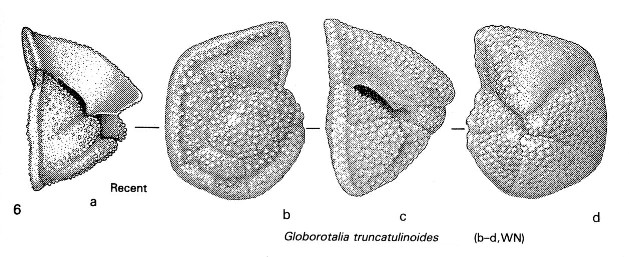
 Hornibrook et al. 1989, Fig. 30.6a-d: 0.50 mm |
Reference: Hornibrook, Brazier & Strong 1989, p.135, Fig. 30:6a-d.
Synonymy: 1839, Rotalia truncatulinoides, in Barker-Webb and Berthelot, Hist. nat. des Iles Canaries, Paris, Bethune, 2(2) zool., p. 132, pl. 2, fig. 25- 27;
1971, G. (Globorotalia) truncatulinoides, Jenkins, N.Z. Geol. Surv. paleont. bull. 42: 98, 99, pl. 6, fig. 158-160 (in part);
1976, Hornibrook, Progress in micropaleontology, spec. publ. Micropal. Press: 83-102;
1981, Hornibrook, N.Z. jl.. geol. geophys. 24(2): 276, 277;
1983, G. (Truncorotalia) truncatulinoides, Kennett & Srinivasan, Neogene Planktonic Foraminifera, p. 148, pl. 34, fig. 2, pl. 35, fig. 4-6, text-fig. 16.
Description: Characterised in Recent populations by the markedly planoconical shape, widely umbilicate and strongly keeled, with five chambers in the final whorl. Aperture a very low, lipped arch.
Distribution: Nukumaruan to Recent (predominantly keeled populations), Castlecliffian to Recent entirely keeled umbilicate populations. Not common in New Zealand onland sequences where the earliest predominantly keeled populations occur in the lower Nukumaruan within a long sequence in which they intergrade with unkeeled or weakly keeled morphotypes of G. tosaensis.
Comment: The earliest, small morphotypes of G. truncatulinoides appear as rare keeled individuals with populations of typical G. tosaensis low in the Mangapanian (Hornibrook 1976; 1981) and these keeled forms gradually dominate and replace unkeeled G. tosaensis in the Nukumaruan. The specimen figured here is from a predominantly keeled population in the Nukumaruan at Waihua R. mouth, Hawkes Bay. Recent populations have a more open umbilicus. The earliest appearance of G. truncatulinoides was widely used as a basal Pleistocene datum following the description by Beggren et al. (1967, Nature 216: 253-254) of its first evolutionary appearance in the Olduvai Subchron in North Atlantic deep-sea core CH61- 171. Backman & Shackleton (1983, Marine Micropaleont. 8: 141- 170) have since shown that the critical interval is disturbed, contains a sedimentary hiatus, and that a correlation with the Olduvai is unsupportable, the FAD of G. truncatulinoides there being placed no younger than 2 m. y. Subsequently the base of the Pleistocene has been fixed at a level just above the Olduvai (1.6 m. y.) at Vrica in Calabria. Judging by populations in DSDP Site 284, entirely keeled populations with an open umbilicus, like those in the Recent, are present in the Castlecliffian. Previous records of G. truncatulinoides in the Opoitian (Jenkins 1971) are G. crassaconica or G. mons.
Cite this publication as: "Strong CP, Raine JI, Terezow M. 2018. Key
species of New Zealand fossil foraminifera: descriptions from "Manual of New
Zealand Permian to Pleistocene Foraminiferal Biostratigraphy" by Hornibrook,
Brazier and Strong, 1989. Lower Hutt (NZ): GNS Science. (GNS Science
miscellaneous series; 123)."
ISSN 1172-2886, ISBN 978-1-98-853088-8,
DOI 10.21420/G2M63W.
This publication is © copyright in 2018 by GNS Science and is licenced for re-use under a Creative Commons Attribution 4.0 International Licence. Please note that this licence does not apply to any included logos, emblems or trade marks.