

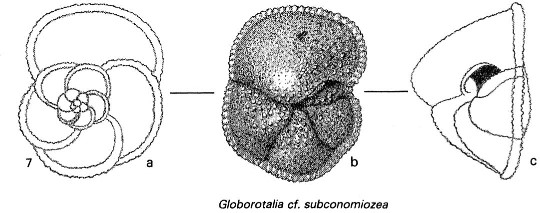
 Hornibrook et al. 1989, Fig. 29.7a-c: |
Reference: Hornibrook, Brazier & Strong 1989, p.134, Fig. 29:7a-c.
Synonymy: 1975, G. conomiozea subconomiozea, Late Neogene Epoch Boundaries, Micropaleontology Spec. Publ. No.1, p. 56-57, Pl. 1, figs. 1A-C, 2A-C;
1982, Globorotalia cf. pliozea, Hornibrook, N.Z. jl. geol. geophys. 25(1): p. 85, fig. 2, p. 95.
Description: Resembles G. pliozea in having only 4½ chambers in the final whorl and a rather broad final chamber. The margins are strongly keeled and the test is typically more planoconvex than pliozea and the aperture is a high arch in contrast to the low aperture of pliozea.
Distribution: Opoitian to basal Waipipian. In the Mangapoike section G. cf. subconomiozea ranges throughout the Opoiti Formation (Opoitian) up into the upper member of the Whakapunake Limestone (basal Waipipian). The specimen figured (0.50 mm) is from DSDP Site 284, core 9-1-100 cm.
Comment: G. H. Scott drew our attention to the resemblance between this species and G. subconomiozea of Bandy which is provisionally adopted as an appropriate name.
Cite this publication as: "Strong CP, Raine JI, Terezow M. 2018. Key
species of New Zealand fossil foraminifera: descriptions from "Manual of New
Zealand Permian to Pleistocene Foraminiferal Biostratigraphy" by Hornibrook,
Brazier and Strong, 1989. Lower Hutt (NZ): GNS Science. (GNS Science
miscellaneous series; 123)."
ISSN 1172-2886, ISBN 978-1-98-853088-8,
DOI 10.21420/G2M63W.
This publication is © copyright in 2018 by GNS Science and is licenced for re-use under a Creative Commons Attribution 4.0 International Licence. Please note that this licence does not apply to any included logos, emblems or trade marks.