

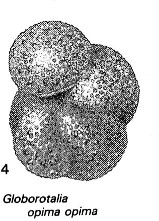
 Hornibrook et al. 1989, Fig. 26.4: 0.48 mm |
Reference: Hornibrook, Brazier & Strong 1989, p.133, Fig. 26:4.
Synonymy: 1957, U.S. Natl. Mus. bull. 215: 117, pl. 28, fig. 1a-2;
1971, Jenkins, N.Z. Geol. Surv. paleont. bull. 42: 128, pl. 13, fig. 354-357 (Turborotalia).
Description: According to Jenkins, G. opima (0.40- 0.50 mm) usually with five chambers in the final whorl, and with a low arched aperture is distinct from G. nana and G. pseudocontinuosa and G. semivera which are also smaller.
Distribution: Mid Whaingaroan to lower Duntroonian.
Comment: This taxon is included here because it is widely regarded as an important zonal species for the Oligocene. The specimen figured is the one figured by Jenkins (1971), redrawn. Its identity in New Zealand is somewhat uncertain. Jenkins gives its range as G. angiporoides-zone to G. dehiscens-zone (Lower Whaingaroan to lower Waitakian). The most convincing populations recognised here are from within the G. euapertura-zone (Mid Whaingaroan to lower Duntroonian, Kokoamu Greensand).
Cite this publication as: "Strong CP, Raine JI, Terezow M. 2018. Key
species of New Zealand fossil foraminifera: descriptions from "Manual of New
Zealand Permian to Pleistocene Foraminiferal Biostratigraphy" by Hornibrook,
Brazier and Strong, 1989. Lower Hutt (NZ): GNS Science. (GNS Science
miscellaneous series; 123)."
ISSN 1172-2886, ISBN 978-1-98-853088-8,
DOI 10.21420/G2M63W.
This publication is © copyright in 2018 by GNS Science and is licenced for re-use under a Creative Commons Attribution 4.0 International Licence. Please note that this licence does not apply to any included logos, emblems or trade marks.