

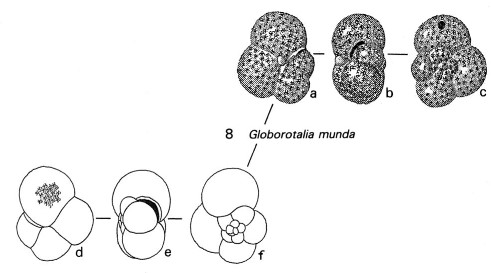
 Hornibrook et al. 1989, Fig. 26.8a-f (Holotype and Paratype): 0.22 mm |
Reference: Hornibrook, Brazier & Strong 1989, p.133, Fig. 26:8a-f (Holotype and Paratype).
Synonymy: 1966, N.Z. jl. geol. geophys. 8(6): 1121, fig. 4, no. 126-133, pl. 13, no. 152-166;
1971 N.Z. Geol. Surv. pal. bull. 42: 123, pl. 12, fig. 328-335 (Turborotalia; Tenuitella).
Description: One of a group of tiny species characteristic of Upper Eocene and Lower Oligocene. Distinguished by the tiny, usually four-chambered finely perforate test with a low arched lipped aperture in a peripheral-umbilical position.
Distribution: Lower Whaingaroan to Duntroonian.
Comment: Because of its very small size, G. munda is only found in sediments that can be disaggregated into a very fine fraction in which juveniles of other, rather similar species are usually abundant. Jenkins interprets populations in the lower Kokoamu Greensand as intergrading with Globigerina juvenilis with a higher spire and umbilical aperture. Morphotypes of G. munda are here recorded from the Earthquakes Marl (G. angiporoides-zone), lower and upper Kokoamu Greensand, and well up into the lower Otekaike Limestone (Upper G. euapertura-zone, Duntroonian) where they show a trend towards a more umbilical aperture. See also G. insolita, G. gemma, G. aculeata and Globigerina juvenilis.
Cite this publication as: "Strong CP, Raine JI, Terezow M. 2018. Key
species of New Zealand fossil foraminifera: descriptions from "Manual of New
Zealand Permian to Pleistocene Foraminiferal Biostratigraphy" by Hornibrook,
Brazier and Strong, 1989. Lower Hutt (NZ): GNS Science. (GNS Science
miscellaneous series; 123)."
ISSN 1172-2886, ISBN 978-1-98-853088-8,
DOI 10.21420/G2M63W.
This publication is © copyright in 2018 by GNS Science and is licenced for re-use under a Creative Commons Attribution 4.0 International Licence. Please note that this licence does not apply to any included logos, emblems or trade marks.