

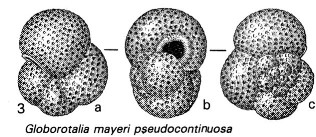
 Hornibrook et al. 1989, Fig. 26.3a-c (Holotype): |
Reference: Hornibrook, Brazier & Strong 1989, p.132, Fig. 26:3a-c (Holotype).
Synonymy: 1967, G. nana pseudocontinuosa, N.Z. jl. geol. geophys. 10(4): 1047, fig. 4, no. 20-25;
1971, G. (Turborotalia) pseudocontinuosa, Jenkins, N.Z. Geol. Surv. paleont. bull. 42: 124, 125, pl. 12, fig. 336-341;
1984, Globorotalia mayeri, Hoskins, Palaeogeog., palaeoclim., palaeoecol. 46(1- 3): 203-216, fig. 8, no. 7-9 (Jenkinsella).
Description: Jenkins proposed this taxon for a four chambered form with a highly arched aperture.
Distribution: Ranging from middle Whaingaroan to middle Southland Series. Populations closely matching the figured specimens are especially characteristic of the Upper Whaingaroan (lower G. euapertura- zone).
Comment: Hoskins demonstrated a very close resemblance of G. pseudocontinuousa to G. semivera and G. mayeri, concluding that they should all be referred to G. mayeri. The separate names are retained here as subspecies of G. mayeri although the taxonomic distinction between 4-chambered individuals (G. pseudocontinuosa from 5 chambered ones G. semivera in what appear to be single populations, is questionable.
Cite this publication as: "Strong CP, Raine JI, Terezow M. 2018. Key
species of New Zealand fossil foraminifera: descriptions from "Manual of New
Zealand Permian to Pleistocene Foraminiferal Biostratigraphy" by Hornibrook,
Brazier and Strong, 1989. Lower Hutt (NZ): GNS Science. (GNS Science
miscellaneous series; 123)."
ISSN 1172-2886, ISBN 978-1-98-853088-8,
DOI 10.21420/G2M63W.
This publication is © copyright in 2018 by GNS Science and is licenced for re-use under a Creative Commons Attribution 4.0 International Licence. Please note that this licence does not apply to any included logos, emblems or trade marks.