

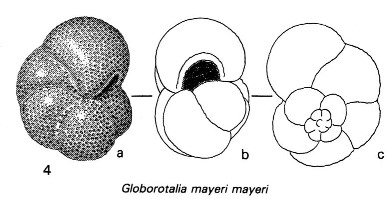
 Hornibrook et al. 1989, Fig. 28.4a-c: 0.35 mm |
Reference: Hornibrook, Brazier & Strong 1989, p.131, Fig. 28:4a-c.
Synonymy: 1939, Contr. Cushman Lab. 15(1): 11, pl. 2, fig. 4a-c;
1968, G. mayeri, Hornibrook, Handbook of N.Z. Microfossils, p.. 87, fig. 17;
1971, G. (Turborotalia) mayeri, Jenkins, N.Z. Geol. Surv. paleont. bull. 42: 120, 121, pl. 11, fig. 297-302;
1983, G. (Jenkinsella) mayeri, Kennett & Srinivasan, Neogene Planktonic Foraminifera, p. 174, pl. 43, fig. 4-6, text-fig. 19;
1984, G. mayeri, Hoskins, Palaeogeogr., palaeoclimat., palaeoecol. 46(1-3): 203-216, fig. 3-5.
Description: Low, trochospiral, periphery broadly rounded, five chambers in last whorl, sutures nearly radial, slightly recurved, surface coarsly porous with a well developed uniform reticulate pore ridge pattern; aperture a high, lipped arch extending from the side of the periphery into the umbilicus.
Distribution: Typical G. mayeri populations are common from Waiauan to lower Tongaporutuan. Individual morphotypes occur as low as Clifdenian or earlier.
Comment: Much confusion has surrounded G. mayeri and other similar taxa (G. nana pseudocontinuosa Jenkins, G. semivera (Hornibrook), G. bella Jenkins, G. continuosa Blow, G. nympha Jenkins, G. siakensis Le Roy). All have been widely recorded and individual ranges have been attributed to them. Jenkins (1971, etc.) based his G. mayeri- zone on the total stratigraphic range of G. mayeri mayeri in Australia and New Zealand, believing that this taxon evolved from G. peripheroronda in the Middle Miocene (upper Lillburnian). Hoskins (1984) convincingly shows that G. peripheroronda belongs to Fohsella, having a more finely perforate test than G. mayeri. The two are unlikely to be closely related. He also questions the validity of several taxa associated with G. mayeri (see above). There do, however, appear to be sufficiently distinctive populations at different levels in the Oligocene and Miocene to justify maintaining a subspecific nomenclature for some of the mayeri group. The ranges attributed to them generally follow Jenkins (1981).
Cite this publication as: "Strong CP, Raine JI, Terezow M. 2018. Key
species of New Zealand fossil foraminifera: descriptions from "Manual of New
Zealand Permian to Pleistocene Foraminiferal Biostratigraphy" by Hornibrook,
Brazier and Strong, 1989. Lower Hutt (NZ): GNS Science. (GNS Science
miscellaneous series; 123)."
ISSN 1172-2886, ISBN 978-1-98-853088-8,
DOI 10.21420/G2M63W.
This publication is © copyright in 2018 by GNS Science and is licenced for re-use under a Creative Commons Attribution 4.0 International Licence. Please note that this licence does not apply to any included logos, emblems or trade marks.