

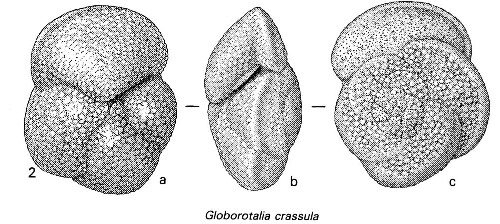
 Hornibrook et al. 1989, Fig. 30.2a-c: 0.52 mm |
Reference: Hornibrook, Brazier & Strong 1989, p.130, Fig. 30:2a-c.
Synonymy: 1930, San Diego Soc. Nat. Hist. trans. 6: 77, pl. 6, fig. 7;
1947, not Globorotalia crassula of Finlay & Marwick, N.Z. jl. sci. tech. B28(4): 235, = G. crassaformis;
1976, Hornibrook, Progress in Micropaleontology, spec. publ. Micropaleontology Press, N.Y. pp. 92-94, pl. 1, fig. 4-7;
1981, N.Z. jl. geol. geophys. 24(2).: 272, fig. 6;
1983, G. (Truncorotalia) crassula, Kennett & Srinivasan, Neogene Planktonic Foraminifera, p. 144, pl. 34, fig. 3-5, text-fig. 16
(included in G. hirsuta records by Jenkins 1971; G. viola Blow is included here in the variation of G. crassula).
Description: Typically low spired, gently convex on spiral side, variably convex on involute side, umbilicate, four chambers in final whorl, margins compressed with a weak keel or rim, aperture a low lipped arch, chambers broad and subtriangular. Surfaces papillate often with much secondary thickening.
Comparison: Distinguished from G. hirsuta by the less convex dorsal side and sinistral coiling habit.
Distribution: Nukumaruan to Recent.
Comment: A considerable range of variability is attributed to G. crassula in its usage here. In fully open sea situations it is fairly thick walled and typical with secondary shell deposits but more inshore it tends to be thinner walled, with a more distinct marginal rim resembling G. viola. In the Pliocene of the Mediterranean, G. crassula goes under the name of G. aemiliana. G. crassula is extremely rare in the Upper Pliocene of the Wanganui district and it has been found only in the Hautawan with rare dextral G. crassaformis i.e., within the narrow overlap-zone of these two species (Hornibrook 1981). At some localities in the East Coast Basin Nukumaruan molluscs are associated with its FAD which is adopted as a working datum to approximate the base of Nukumaruan.
Cite this publication as: "Strong CP, Raine JI, Terezow M. 2018. Key
species of New Zealand fossil foraminifera: descriptions from "Manual of New
Zealand Permian to Pleistocene Foraminiferal Biostratigraphy" by Hornibrook,
Brazier and Strong, 1989. Lower Hutt (NZ): GNS Science. (GNS Science
miscellaneous series; 123)."
ISSN 1172-2886, ISBN 978-1-98-853088-8,
DOI 10.21420/G2M63W.
This publication is © copyright in 2018 by GNS Science and is licenced for re-use under a Creative Commons Attribution 4.0 International Licence. Please note that this licence does not apply to any included logos, emblems or trade marks.