

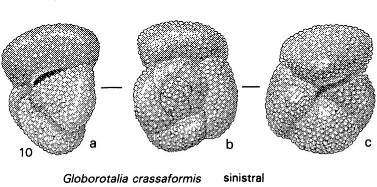
 Hornibrook et al. 1989, Fig. 29.10: 0.37 mm |
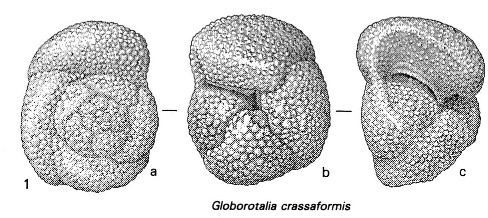 Hornibrook et al. 1989, Fig. 30.1a-c: 0.37 mm |
Reference: Hornibrook, Brazier & Strong 1989, p.129, Fig. 29:10, 30:1a-c.
Synonymy: 1927, Globigerina crassaformis, Calif. jl. paleont. 1: 41, pl. 7, fig. 12;
1971, Globorotalia (G.) crassaformis, Jenkins, N.Z. Geol. Surv. paleont. bull. 42: 86-88, pl. 4, fig. 105-107;
1980, Scott, N.Z. jl. geol. geophys. 25: 83-99; 1981, Hornibrook, Ibid. 24(2): 263-292;
1982, Hornibrook, Ibid. 25: 83-99; 1983, G. (Truncorotalia) crassaformis, Kennett & Srinivasan, Neogene Planktonic Foraminifera, p. 146, pl. 34, fig. 6-8, text-fig. 143;
1983, Scott, Marine micropal. 7: 369- 383; 1984, Hornibrook, Palaeogeogr., palaeoclimat., palaeoecol. 46(1- 3): 107-117, fig. 1.
Description: Subquadrate, flattened on spiral side, strongly convex and rounded on ventral side, strongly umbilicate, aperture a very low, rimmed slit, periphery rounded without a keel, four chambers in final whorl.
Distribution: Opoitian to Nukumaruan.
Comment: The description and illustrations given here agree with topotypes from Lomita Quarry, Pleistocene, California, and with New Zealand Pliocene populations. There is much confusion over the identity and distribution of this taxon to which a variety of forms, some with peripheral keels, have been referred. The earliest forms appear in New Zealand close to the base of the Opoitian (basal reversed interval of Gilbert chron) as populations of small, rounded individuals with slit-apertures. Higher in the Pliocene, populations become more subquadrate and typical. Keeled forms in DSDP Site 284, in the Pleistocene, are probably a separate taxon (Hornibrook 1982) and records of G. crassaformis above Nukumaruan are doubtful. In the Opoitian and Waipipian, populations are predominantly sinistrally or randomly coiling becoming predominantly dextral in the Mangapanian and Lower Nukumaruan and reverting to sinistral higher in the Nukumaruan (Hornibook 1981). See G. crassaconica.
Cite this publication as: "Strong CP, Raine JI, Terezow M. 2018. Key
species of New Zealand fossil foraminifera: descriptions from "Manual of New
Zealand Permian to Pleistocene Foraminiferal Biostratigraphy" by Hornibrook,
Brazier and Strong, 1989. Lower Hutt (NZ): GNS Science. (GNS Science
miscellaneous series; 123)."
ISSN 1172-2886, ISBN 978-1-98-853088-8,
DOI 10.21420/G2M63W.
This publication is © copyright in 2018 by GNS Science and is licenced for re-use under a Creative Commons Attribution 4.0 International Licence. Please note that this licence does not apply to any included logos, emblems or trade marks.