

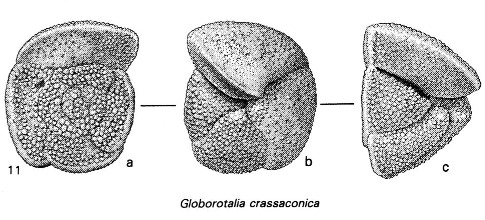
 Hornibrook et al. 1989, Fig. 29.11a-c: 0.42 mm |
Reference: Hornibrook, Brazier & Strong 1989, p.129, Fig. 29:11a-c.
Synonymy: 1971, G. truncatulinoides (in part) Jenkins, N.Z. Geol. Surv. paleont. bull. 42: 61, table 49;
1981, G. crassaconica, Hornibrook, N.Z. jl. geol. geophys. 24(2): 263-292, fig. 5, 9;
1982, Hornibrook, Ibid. 25: 83-99 (Truncorotalia).
Description: Markedly plano-convex, triangular and conical in crosssection; chambers sharply angled and peaked in umbilical area; ventral sutures gently recurved, dorsal sutures abruptly recurved at junction of chambers, periphery distinctly rimmed or keeled, surface densely hispid; aperture a low, lipped slit.
Distribution: Opoitian to Waipipian.
Comment: Populations of keeled forms have previously been included as variants of G. crassaformis but their different range and independent preferential coiling directions are additional reasons for a separate taxon. A keeled form of the crassaformis group in the Pleistocene is easily confused with G. crassaconica. See under G. crassaformis.
Cite this publication as: "Strong CP, Raine JI, Terezow M. 2018. Key
species of New Zealand fossil foraminifera: descriptions from "Manual of New
Zealand Permian to Pleistocene Foraminiferal Biostratigraphy" by Hornibrook,
Brazier and Strong, 1989. Lower Hutt (NZ): GNS Science. (GNS Science
miscellaneous series; 123)."
ISSN 1172-2886, ISBN 978-1-98-853088-8,
DOI 10.21420/G2M63W.
This publication is © copyright in 2018 by GNS Science and is licenced for re-use under a Creative Commons Attribution 4.0 International Licence. Please note that this licence does not apply to any included logos, emblems or trade marks.