

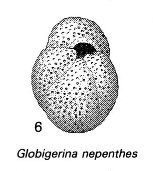
 Hornibrook et al. 1989, Fig. 28.6: 0.29 mm |
Reference: Hornibrook, Brazier & Strong 1989, p.127, Fig. 28:6.
Synonymy: 1957, U.S. Geol. Surv. prof paper 280-H: 301, fig. 7a, b;
1971, Jenkins, N.Z. Geol. Surv. paleont. bull. 42: 151, 152, pl. 16, fig. 485-488;
1978, Hoskins, New Zealand Middle Miocene foraminifera: The Waiauan Stage. Unpublished Ph.D. thesis, N.Z. Geol. Surv. Library;
1983, G. (Zeaglobigerina) nepenthes, Kennett & Srinivasan, Neogene Planktonic Foraminifera: 48, pl. 9, fig. 1-3.
Description: Distinguished by the characteristic compact shape with a lipped, umbilically situated aperture, coarsely perforate wall and tendency for the final chamber to protrude beyond the earlier ones.
Comparison: This species occurs in its most typical form in tropical faunas. New Zealand populations tend to be more compactly chambered.
Distribution: Waiauan to Opoitian (Hoskins, 1978).
Comment: Waiauan to Opoitian (Hoskins, 1978). Present throughout most of the Opoitian. Rare specimens in the Whakapunake limestone (upper Opoitian) are possibly reworked.
Cite this publication as: "Strong CP, Raine JI, Terezow M. 2018. Key
species of New Zealand fossil foraminifera: descriptions from "Manual of New
Zealand Permian to Pleistocene Foraminiferal Biostratigraphy" by Hornibrook,
Brazier and Strong, 1989. Lower Hutt (NZ): GNS Science. (GNS Science
miscellaneous series; 123)."
ISSN 1172-2886, ISBN 978-1-98-853088-8,
DOI 10.21420/G2M63W.
This publication is © copyright in 2018 by GNS Science and is licenced for re-use under a Creative Commons Attribution 4.0 International Licence. Please note that this licence does not apply to any included logos, emblems or trade marks.