

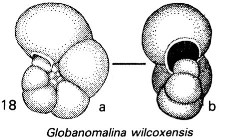
 Hornibrook et al. 1989, Fig. 24.18a-b: 0.25 mm |
Reference: Hornibrook, Brazier & Strong 1989, p.125, Fig. 24:18a-b.
Synonymy: 1932, Nonion wilcoxensis, Contr. Cushman Lab. 8(3): 64, pl. 8, fig. 11;
1958a, Globigerina pseudoiota, Hornibrook, Micropaleontology 4(1): 34, pl. 1, fig. 16-18
1958b, Hornibrook, N.Z. jl. geol. geophys. 1(4): 664, fig. 23, 26-28;
1971, Globanomalina wilcoxensis, Jenkins, N.Z. Geol. Surv. paleont. bull. 42: 79, pl. 3, fig. 55-61;
1982, Banner in Banner & Lord (ed.) Aspects of Micropaleontology, George Unwin & Allen, pp. 158, 163, fig. 5.35 (Pseudohastigerina).
Description: Distinguished by the tiny smooth slightly asymmetrically coiled form with a high arched peripheral aperture.
Distribution: Lower Waipawan (not basal) to lower Mangaorapan.
Comment: The gradation of populations of G. wilcoxensis into Pseudohastigerina micra in the Lower Eocene was first demonstrated in New Zealand. The generic assignments used here follow Jenkins and Banner. The FAD of G. wilcoxensis (as Pseudohastigerina) has been widely adopted as the base of the Eocene ("Pseudohastigerina datum") which is within the lower part of the Waipawan.
Cite this publication as: "Strong CP, Raine JI, Terezow M. 2018. Key
species of New Zealand fossil foraminifera: descriptions from "Manual of New
Zealand Permian to Pleistocene Foraminiferal Biostratigraphy" by Hornibrook,
Brazier and Strong, 1989. Lower Hutt (NZ): GNS Science. (GNS Science
miscellaneous series; 123)."
ISSN 1172-2886, ISBN 978-1-98-853088-8,
DOI 10.21420/G2M63W.
This publication is © copyright in 2018 by GNS Science and is licenced for re-use under a Creative Commons Attribution 4.0 International Licence. Please note that this licence does not apply to any included logos, emblems or trade marks.